

Blog
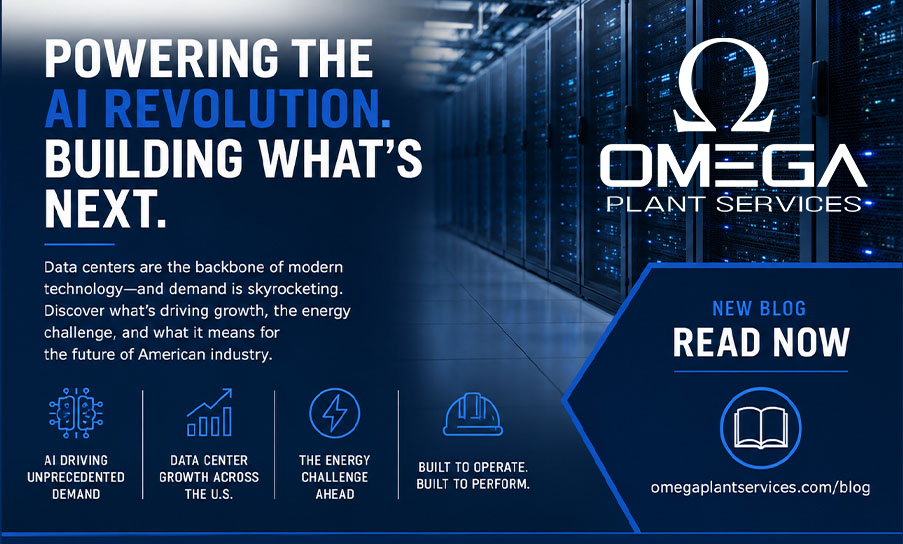
The Data Center Boom: How AI Is Reshaping America’s Infrastructure
Artificial Intelligence is transforming nearly every aspect of modern life—from how businesses operate and how consumers shop to how medical research is conducted and how industries optimize performance. Behind every AI-powered tool, cloud application, streaming service, and digital transaction lies an often-overlooked piece of critical infrastructure: the data center.
Today, data centers have become one of the fastest-growing infrastructure sectors in the United States, and their importance will only continue to increase as AI adoption accelerates.
The Digital Backbone of Modern Society
Data centers are the physical facilities that store, process, and distribute the enormous amounts of data required to power the digital economy. Every email sent, video streamed, online purchase completed, and AI query processed depends on data center infrastructure operating behind the scenes.
The United States currently leads the world in data center development, accounting for nearly half of all operational data centers globally. As of late 2025, more than 5,400 data centers were operating across the country, making the U.S. the largest data center market in the world.
While data centers have supported the internet for decades, the rise of Artificial Intelligence has created an entirely new level of demand.
AI Is Driving Unprecedented Growth
Unlike traditional computing workloads, AI applications require massive amounts of processing power. Large language models, machine learning systems, and generative AI platforms rely on thousands of advanced processors operating simultaneously to train models and deliver real-time results.
As AI adoption expands across industries, demand for data center capacity is accelerating at historic rates.
According to Goldman Sachs Research, U.S. data center power demand is expected to more than double by 2027, growing from approximately 31 gigawatts in 2025 to 66 gigawatts by 2027.
Industry analysts project that global data center capacity could double between 2026 and 2030, with nearly 100 gigawatts of new capacity expected to come online during that period.
Major technology companies—including Microsoft, Amazon, Google, Meta, and others—are investing hundreds of billions of dollars into AI infrastructure to support future growth. Goldman Sachs estimates that AI-related infrastructure spending could exceed $7 trillion globally over the next several years.
Why Data Centers Matter Beyond Technology
While data centers are often associated with Silicon Valley and cloud computing, their impact extends far beyond the technology sector.
Data centers support:
- Artificial Intelligence and machine learning
- Healthcare and medical research
- Financial services and banking
- Manufacturing and industrial automation
- Energy and utility operations
- National defense and cybersecurity
- Telecommunications and global connectivity
In many ways, data centers have become as essential to modern society as highways, airports, and power generation facilities.
The continued growth of AI is turning data centers into mission-critical infrastructure that supports economic growth, innovation, and global competitiveness.
The Energy Challenge
One of the most significant consequences of the data center boom is its growing demand for electricity.
The U.S. Department of Energy estimates that data center load growth has tripled over the past decade and could double or triple again by 2028.
The International Energy Agency projects that electricity consumption from data centers could double by 2030, with AI-focused facilities driving a substantial portion of that increase.
As a result, utilities, power producers, and industrial operators are facing new challenges in expanding generation capacity, strengthening transmission infrastructure, and ensuring reliable power delivery to support future demand.
This growing need for power is creating opportunities across multiple sectors, including power generation, renewable energy, natural gas infrastructure, industrial construction, and plant operations.
The Rise of Mission-Critical Facilities
Modern hyperscale data centers are among the most complex facilities ever built.
They require:
- High-voltage electrical systems
- Backup power generation
- Advanced cooling technologies
- Sophisticated automation and controls
- Redundant systems designed for continuous uptime
Even minor disruptions can result in significant operational and financial consequences, making reliability a top priority.
This complexity has increased demand for experienced professionals who understand commissioning, startup, operations, maintenance, reliability, and performance optimization.
The same disciplines that have long supported industrial facilities, power plants, refineries, and manufacturing operations are now becoming increasingly valuable within the data center sector.
What This Means for the Future
The rapid expansion of AI is not a short-term trend. It represents a fundamental shift in how information is created, processed, and utilized across the global economy.
As demand for computing power grows, so too will the need for the facilities that support it.
The future of AI depends on reliable infrastructure. The future of that infrastructure depends on experienced teams capable of planning, commissioning, operating, and maintaining increasingly complex systems.
For companies that specialize in operational excellence, reliability, and plant performance, the data center market represents one of the most significant growth opportunities of the coming decade.
At Omega Plant Services, we recognize that the infrastructure supporting tomorrow’s digital economy requires the same commitment to safety, reliability, and operational discipline that has always driven success in industrial environments.
Because whether it’s powering a refinery, manufacturing facility, or the next generation of AI infrastructure, performance begins with execution.
Omega Plant Services — Built To Perform. Proven To Deliver.